
The Best Interventions for Reducing Loneliness
A gigantic new meta-analysis supports a decades old conception of loneliness


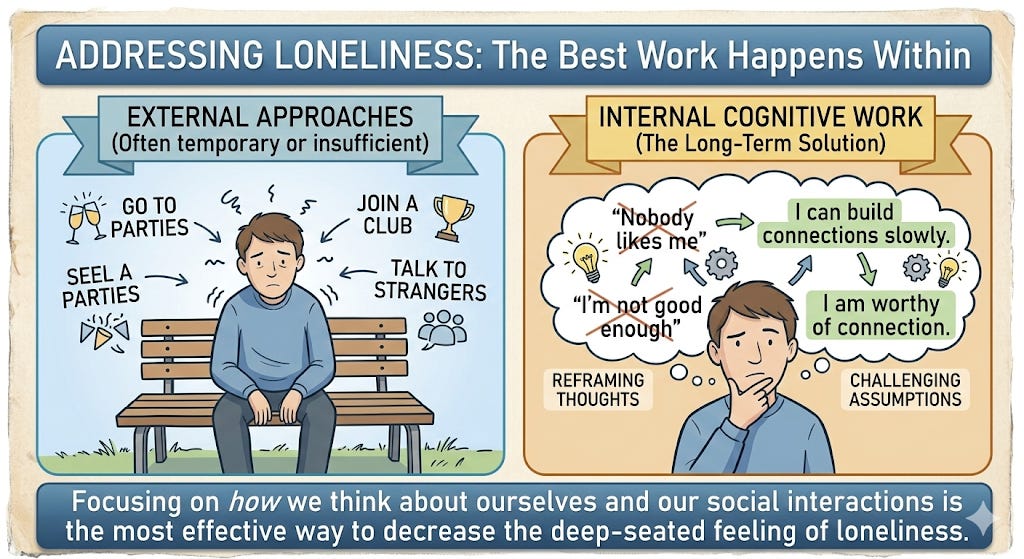
The best way to deal with loneliness isn’t to just “get out there” and join groups. Loneliness, according to the latest and largest synthesis of research on interventions, is better conceptualized as coming from an internal attitude towards the world. As we’ll see, the best interventions aim to change patterns of thinking.
In 2026 a huge meta-analysis of 280 studies aimed at reducing loneliness, with a cumulative 30,000+ participants, provided a state-of-the-field snapshot into what worked best. The analysis demonstrates that loneliness interventions are generally effective, yielding a small to moderate short-term effect (Standardized Mean Difference [SMD]1 = -0.50 in randomized controlled trials [RCTs]). These effects are largely sustained in the long term (1–6 months post-intervention).
What’s more interesting is the comparisons between types of interventions. The authors grouped interventions according to their approach to reducing loneliness. They found the following effect sizes:
Social Support Interventions
Mechanism: Provides regular care and companionship (e.g., befriending, mentorship).
Effectiveness: Small effect (k = 36; SMD = -0.32, 95% CI [-0.47, -0.16]).
Statistically significantly smaller effect than other strategies (p = .016).
Social Network Interventions
Mechanism: Expands social circles by creating opportunities for interaction (e.g., community groups, choirs, art programs).
Effectiveness: Small to moderate effect (k = 22; SMD = -0.46, 95% CI [-0.72, -0.20]).
Social and Emotional Skills Training
Mechanism: Equips individuals to better form and maintain relationships (e.g., role-playing, conversation training).
Effectiveness: Small to moderate effect (k = 24; SMD = -0.42, 95% CI [-0.64, -0.20]).
Psychological Interventions
Mechanism: Addresses maladaptive social cognitions, hypervigilance, and emotions through therapy (e.g., CBT, mindfulness).
Effectiveness: Moderate to large effect (k = 48; SMD = -0.59, 95% CI [-0.77, -0.41]).
These are theoretically underpinned by the “evolutionary theory of loneliness,” which posits that chronic loneliness is maintained by unconscious processes and social cognitive biases.
The first two interventions mentioned—social support interventions and social network interventions—correspond to most closely to the “obvious” advice to just get out there and meet new people. These interventions aim at creating new relationships. These interventions do work. Meeting and being around new people is helpful. But they have modest effect sizes.
The social and emotional skills training, which feels like another obvious approach to try—“hey, let’s get people better at making and keeping friends”—was also effective, but only moderately so.
The biggest winner here was actually conventional therapeutic techniques like cognitive behavioral therapy (CBT). These techniques often explicitly challenge negative beliefs, which can be self-reinforcing. The “loneliness loop” typically looks like a lonely person being on guard or vigilant for social rejection, which actually makes them more likely to notice or perceive social slights, and to then make a bigger deal out of them. This biased perception—focusing on rejection—then creates more loneliness.
I have given psycho-education lectures to mental health patients about attachment style before, which is another powerful framework for understanding social connection. Qualitative research, I tell them, shows that you typically need to do internal work before you can start doing the external work of building more secure relationships. The loneliness research is bearing this out. The best way to come out of loneliness isn’t to just take a pottery class or join a zumba class. It’s to start by working on yourself, and the way that you perceive the world.
Of course, there’s an important caveat to put on the “headline finding” of this study: group therapy outperformed individual therapy in reducing loneliness.
Group-based: SMD = -0.59.
Individual-based: SMD = -0.31.
Statistical Significance: Larger effect for group-based (p = .004).
So what you really need, then, is a group of people who are committed to doing the psychological work together. This means having the group, as a whole, work on their cognitive biases. It’s hard to find people willing to be open and vulnerable enough to change in a group setting like this. But it’s a really powerful experience if you can.
SMD is typically synonymous with Cohen’s d, but is technically a broader category of measures that allows for multiple methods of calculating the pooled SD.
Enjoy your solitude.